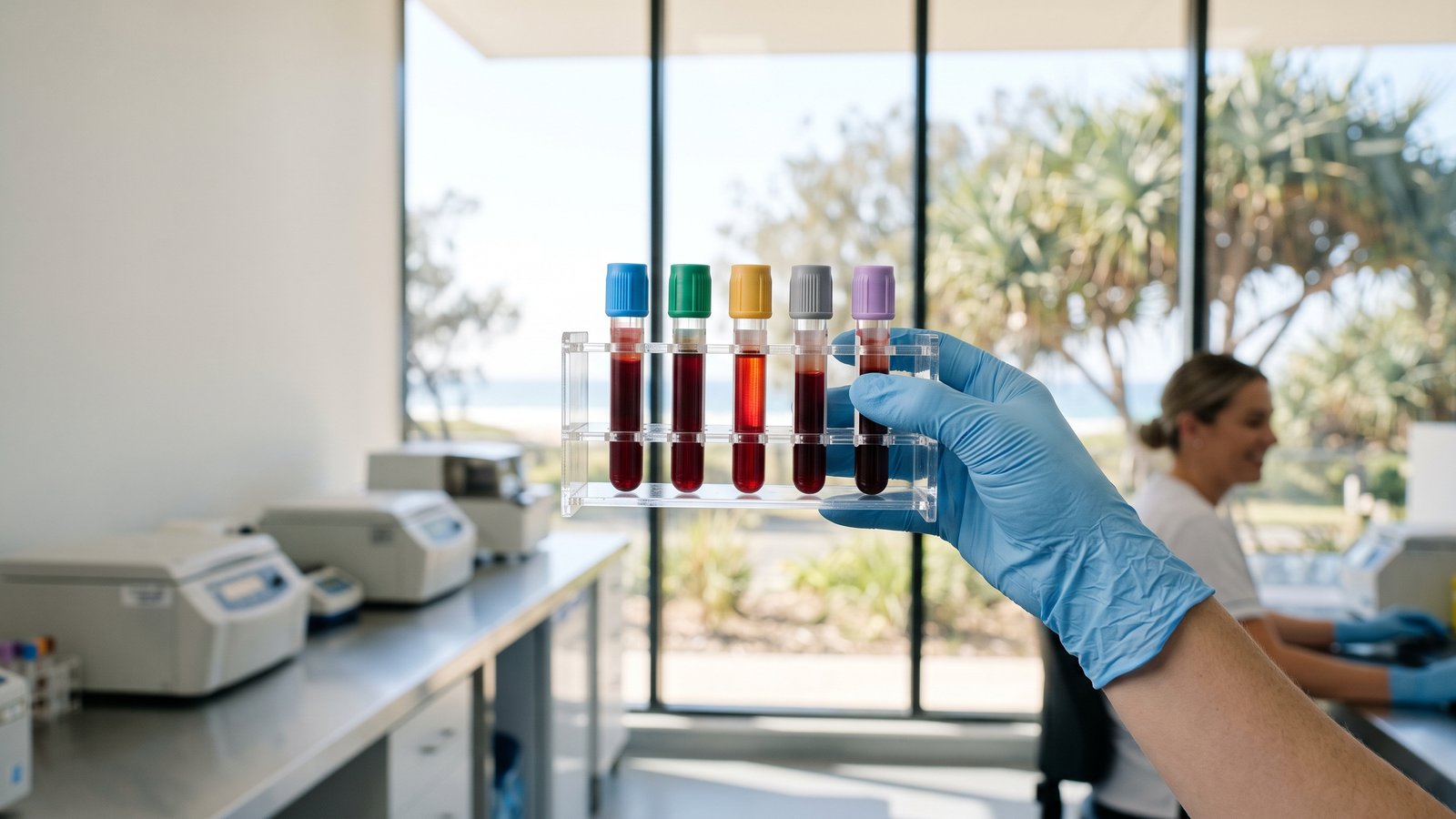
Blood is easy to take for granted. It circulates constantly, does a remarkable amount of work, and most people never think about it until a needle goes into their arm.
It is also the reason a blood test can tell you so much. Understanding what blood is made of makes a results page considerably less opaque — because every line on it is measuring one of these components.
What blood actually does
The average adult carries just under five litres of blood in circulation.1 It performs several jobs at once:
- Carrying oxygen from the lungs to the tissues, and carbon dioxide back the other way
- Delivering nutrients around the body
- Forming clots to limit blood loss after an injury
- Carrying the cells and antibodies that fight infection
- Moving waste products to the kidneys and liver to be filtered
- Helping regulate body temperature
The four components
Plasma is the liquid portion — a mixture of water, salts, sugars, fats and proteins.2 It is the medium everything else travels in, carrying nutrients, hormones, antibodies, clotting proteins and waste.
Red blood cells are the most abundant, making up roughly 40 to 45 per cent of blood volume.2 They carry oxygen using haemoglobin, the protein that also gives blood its colour.
White blood cells account for about one per cent of blood volume2 and do the immune work. Several different types exist, each responding to different kinds of threat, which is why a results page often breaks them down individually.
Platelets are small cell fragments that respond to injury by clumping together and forming a clot.
How this shows up on a results page
The full blood count — sometimes called a complete blood count — is the test that measures these components, and it is one of the most commonly ordered blood tests there is.
It reports on all three cell types. For red cells it typically includes haemoglobin, the oxygen-carrying protein, and haematocrit, the proportion of your blood made up of red cells, alongside measures of average cell size. For white cells it gives a total count and usually a breakdown by type. And it reports a platelet count.
Because these components respond to so many different things, the full blood count gives a clinician a broad view rather than a specific answer. It is often the first test ordered and the one that indicates where to look next.
Blood types, briefly
Red blood cells carry a coating of sugars and proteins called antigens, inherited from your parents. Which antigens you have determines your blood type.3
The ABO system sorts blood into types A, B, AB and O based on which antigens are present. The Rh system adds a positive or negative depending on whether a particular antigen — the D antigen — is there as well. Together they produce the eight familiar groups: O positive, O negative, A positive, and so on.
Blood typing is not part of a standard health panel. It is done when it matters clinically, most obviously before a transfusion, and during pregnancy care.
What a full blood count won't tell you
- It isn't a diagnosis. It describes your blood cells. Interpreting what that means requires a clinician who knows your history and symptoms.
- It doesn't cover everything. Cholesterol, glucose, thyroid, iron stores, liver and kidney function are all separate measurements.
- A flagged result is common. Reference ranges are built to cover most healthy people, which means some healthy people sit outside them.
- Recent illness shows up. An infection in the preceding weeks can move several of these numbers.
The bottom line
Blood carries oxygen, nutrients, immune cells and waste, and it does all of it at once. A full blood count is a snapshot of the cellular side of that system.
It is a broad opening question rather than a specific answer — which is exactly why it appears on almost every panel.
Sources
- National Blood Authority. (n.d.). About blood. https://blood.gov.au/about-blood
- American Society of Hematology. (n.d.). Blood basics. https://www.hematology.org/education/patients/blood-basics
- The Royal Children's Hospital Melbourne. (n.d.). Blood groups and compatibilities. https://www.rch.org.au/bloodtrans/about_blood_products/blood_groups_and_compatibilities/
Optima Stasis clinical team
Reviewed 16 August 2026. Health Hub articles are reviewed by our clinical team and revisited as guidance changes.