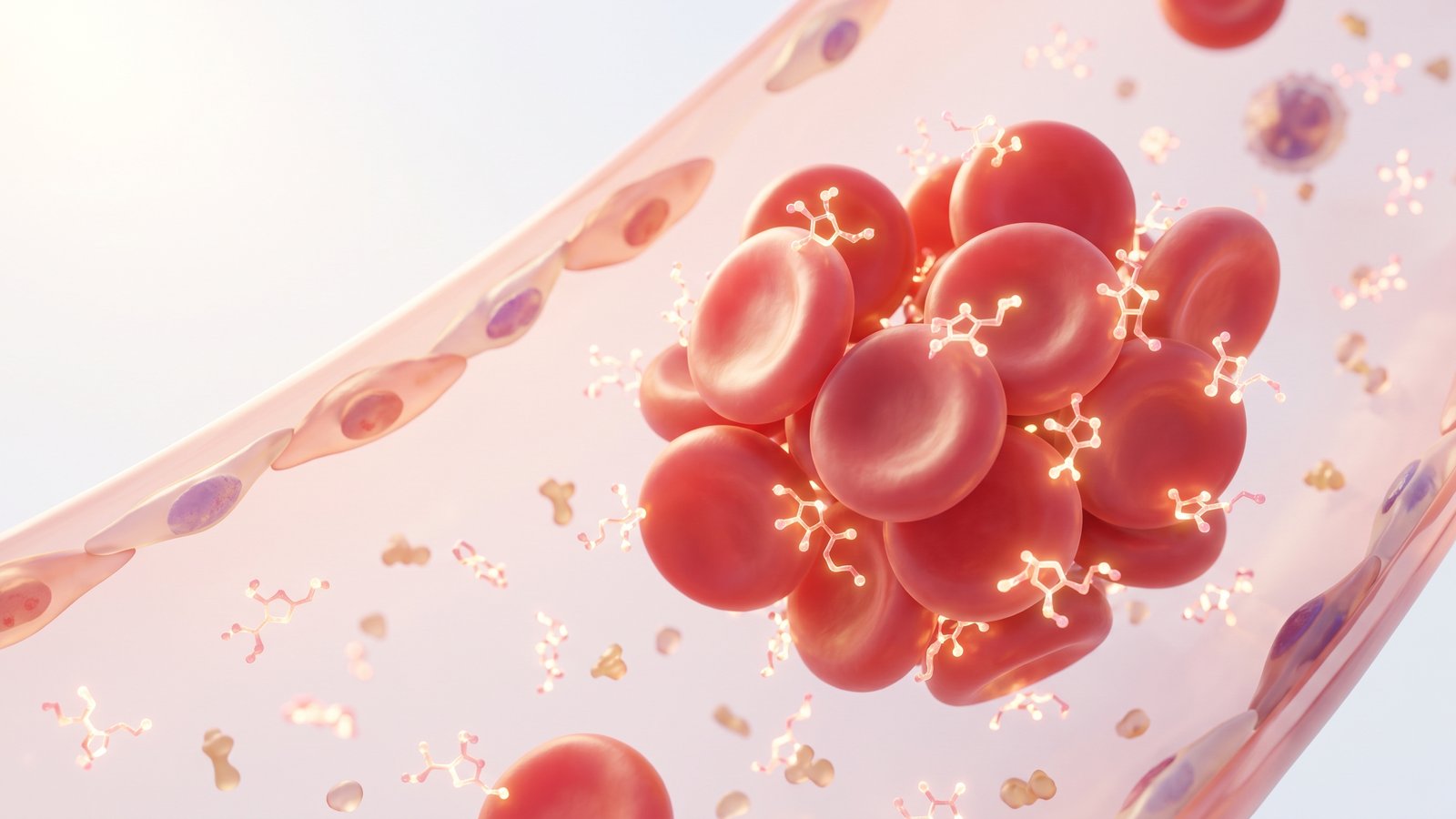
HbA1c smooths out the daily noise in blood glucose and shows the longer trend — roughly three months' worth in a single number.
What HbA1c is
The name stands for glycated haemoglobin. Haemoglobin is the oxygen-carrying protein in red blood cells; when glucose is circulating, some of it binds to haemoglobin and stays attached for the life of that cell.
The higher your average glucose, the greater the proportion of haemoglobin carrying it. Since red blood cells live around 120 days, the measurement reflects roughly the preceding two to three months, weighted toward the more recent weeks.
Why it's useful
A fasting glucose test measures one moment. Glucose moves constantly with food, activity, illness and stress, so a single reading can be unrepresentative.
HbA1c cannot be gamed by fasting or by a good week. It reflects the average, which makes it the more stable measure and the reason it is used both for assessment and for tracking over time.
What the numbers mean
HbA1c is reported either as a percentage or in mmol/mol, and both units appear in Australia and New Zealand. Laboratories generally report both, or one with the other in brackets.
Clinicians work to established thresholds. Below a defined level is considered normal, an intermediate band indicates increased risk, and a figure at or above the diagnostic threshold supports a diagnosis of diabetes — though a diagnosis is never made on one test alone, and confirmation is standard.
For anyone already diagnosed, target levels are individual. They depend on age, how long someone has had diabetes, other health conditions and what is realistic — which is a discussion with a treating doctor rather than a universal number.
When HbA1c is unreliable
This is worth knowing, because it applies more often than people expect.
Because the test depends on red blood cells and their lifespan, anything affecting them affects the result. Conditions that shorten red cell survival, some inherited haemoglobin variants, recent blood transfusion and significant liver disease can all lower it misleadingly. Iron deficiency and B12 deficiency can raise it.
HbA1c is also not appropriate in some situations at all — in pregnancy, in children and young people, where symptoms have been present only briefly, or where glucose is changing rapidly. In these cases other tests are used instead.
Retesting
Because the measurement covers about three months by design, retesting after a few weeks largely measures the same period twice. Intervals are set accordingly — typically several months, and more frequently only where something has changed.
What HbA1c won't tell you
- It doesn't show variability. Two people with the same average can have very different daily swings.
- It isn't a diagnosis on its own. Confirmation and clinical context are required.
- It's affected by red cell conditions. Anaemia and haemoglobin variants distort it in both directions.
- It won't respond quickly. Changes take weeks to register, by design.
The bottom line
HbA1c is the most stable measure of glucose control available, precisely because it averages. That strength is also its limitation — it tells you the trend, not the pattern within it.
Sources
- Pathology Tests Explained. (n.d.). Test index. https://pathologytestsexplained.org.au/
- Royal College of Pathologists of Australasia. (n.d.). Pathology tests. https://www.rcpa.edu.au/Manuals/RCPA-Manual/Pathology-Tests
Optima Stasis clinical team
Reviewed 16 August 2026. Health Hub articles are reviewed by our clinical team and revisited as guidance changes.