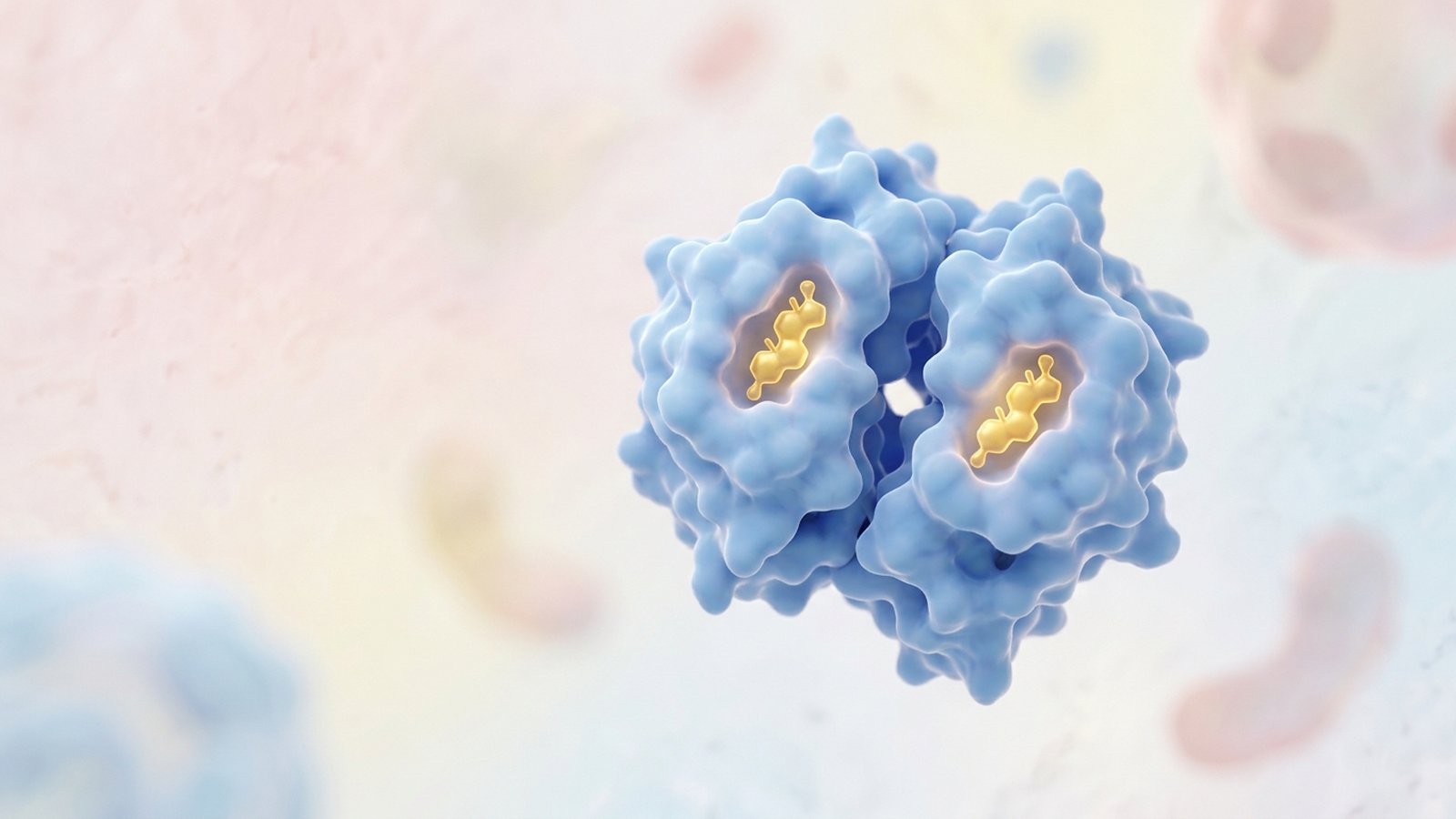
SHBG never gets top billing on a hormone panel, and it quietly decides what the headline numbers mean.
What SHBG is
Sex hormone binding globulin is a protein made by the liver. Its job is transport: it binds sex hormones — testosterone and oestradiol chiefly — and carries them through the bloodstream.
The catch is that a bound hormone is an inactive hormone. While attached to SHBG, testosterone cannot act on tissue. So SHBG functions as a reservoir and a regulator at once: how much of it you have determines how much of your hormone supply is actually available.
Why it's measured
Almost never for its own sake. SHBG earns its place because total testosterone alone can mislead in both directions.
Someone with a normal total and high SHBG can have too little free testosterone available. Someone with a low total and low SHBG can have a perfectly adequate free level. Without SHBG, those two people look the opposite of what they are.
That is why laboratories measure SHBG alongside total testosterone and calculate the free fraction from the pair, and why in women the relationship is often expressed as the free androgen index — total testosterone relative to SHBG.
What the numbers mean
Reference ranges vary by laboratory, by sex and with age — women's ranges run considerably higher than men's, and levels in men tend to rise gradually with age. Read your own report's range rather than a general figure.
The number matters mainly in combination: the same SHBG result changes meaning entirely depending on the total testosterone sitting next to it.
What moves SHBG
Higher SHBG is associated with ageing, an overactive thyroid, liver conditions, low body weight, and oestrogen — including oestrogen-containing contraception, which raises it substantially.
Lower SHBG is associated with higher body fat and insulin resistance, an underactive thyroid, and androgens. The link with insulin resistance is strong enough that a low SHBG sometimes prompts a look at metabolic health more broadly.
What SHBG won't tell you
- It isn't a hormone. SHBG is the carrier, not the cargo — it has no symptoms of its own.
- It means nothing alone. The value is entirely in combination with total testosterone.
- It doesn't diagnose. A shifted SHBG points toward thyroid, liver or metabolic questions; it doesn't answer them.
- Medication context matters. Hormonal contraception moves it enough that results are read differently — your doctor needs to know what you take.
The bottom line
SHBG is the adjustment factor for the sex hormone numbers people actually care about. If you have ever wondered how a testosterone result can be "normal" while something still feels off — or vice versa — this protein is usually where the explanation lives.
Sources
- Pathology Tests Explained. (n.d.). Sex hormone binding globulin (SHBG). https://pathologytestsexplained.org.au/
- Royal College of Pathologists of Australasia. (n.d.). SHBG. RCPA Manual. https://www.rcpa.edu.au/Manuals/RCPA-Manual/Pathology-Tests
Optima Stasis clinical team
Reviewed 17 August 2026. Health Hub articles are reviewed by our clinical team and revisited as guidance changes.